Where Designers Live: How the Studio Environment Shapes Every Stitch
There is a persistent mythology in fashion that creativity arrives fully formed — a vision descending upon the designer like weather, independent of circumstance. The reality is far more grounded. What surrounds a designer each day, the quality of afternoon light falling across a cutting table, the precise arrangement of fabric swatches pinned to a reference wall, the hum of a workspace that has been deliberately composed — all of it enters the work. Not metaphorically, but structurally. The studio is, in the most literal sense, the first design decision a fashion house makes.
At Joan Design, this understanding is not incidental to the creative process. It is foundational to it.
The Studio as a Primary Material
Contemporary design culture has grown increasingly attentive to the conditions under which creative work is produced. Architects have long understood that the spaces they occupy inform the spaces they imagine. Industrial designers speak openly about the relationship between workshop organization and the precision of the objects that emerge from it. Fashion, by contrast, has been slower to articulate this connection — perhaps because clothing, as a finished object, moves so far from its origins.
But the origins matter. A studio built around abundance — overflowing racks, competing references, layered visual noise — tends to produce a different kind of collection than one organized around restraint. Neither is inherently superior. Both, however, are honest. The studio tells the truth about the designer's values before a single pattern piece is drafted.
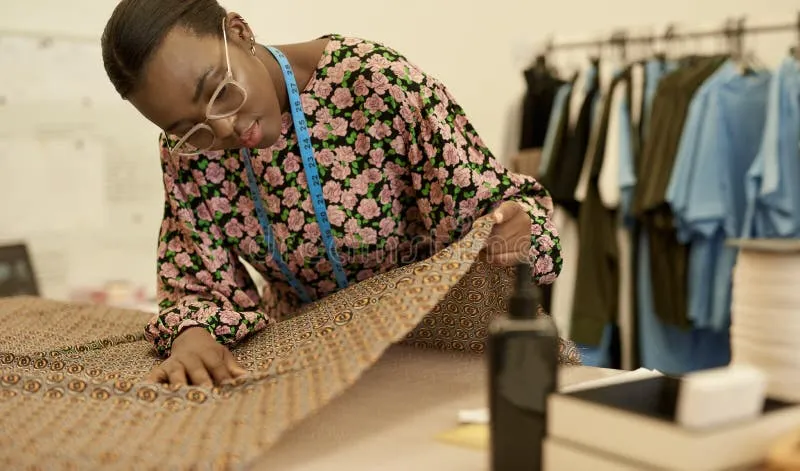
At Joan Design, the workspace is arranged with the same editorial discipline applied to the collections themselves. Surfaces are kept clear except for the work actively in progress. Material libraries are organized not by fiber content alone, but by the visual and tactile weight of each fabric — the way a cloth reads from across a room, and the way it communicates through touch. This dual consideration, how something looks and how it feels, mirrors precisely the standard applied to every finished garment.
Light as a Design Tool
Few environmental factors influence the perception of color, texture, and proportion more profoundly than light. Studios lit with harsh fluorescents flatten the dimensional quality of fabric and distort color relationships in ways that only become apparent once a garment leaves the building. Natural light, and the considered use of warm artificial sources where daylight is limited, allows a designer to evaluate cloth and construction under conditions closer to how a garment will actually be worn.
This is not a small distinction. A silk charmeuse that reads as a warm champagne under incandescent light may shift toward a cooler ivory in the afternoon sun streaming through a showroom window. A wool crepe with subtle surface texture may appear flat under overhead fluorescence and reveal its full character only when light crosses it at an angle. Designing under the right light is not an aesthetic luxury — it is a technical necessity.
At Joan Design, the studio prioritizes natural north-facing light wherever possible, supplemented by adjustable warm-spectrum sources for evening work. The result is a consistency between what is designed and what is ultimately produced — a fidelity between intention and outcome that the studio environment makes possible.
The Material Library as Creative Archive
Every serious design studio maintains some form of material library, but the character of that archive reflects the character of the design practice. A library organized purely by season or vendor is a logistical tool. A library organized by hand, weight, surface quality, and tonal relationship is a creative one.
At Joan Design, fabric and trim samples are curated over time with the same care applied to building a personal wardrobe. Materials that do not meet a defined standard of quality or coherence are not retained simply because they are available. What remains is a working archive of references that consistently reinforces the studio's aesthetic position — a tactile vocabulary that designers can consult, juxtapose, and build upon across multiple collections.
This kind of material continuity has a measurable effect on design output. When a studio's reference library reflects a coherent point of view, the collections that emerge from it tend to share a recognizable sensibility — not through repetition, but through a consistent underlying logic. The material library becomes a form of institutional memory, preserving the aesthetic decisions that have proven most resonant over time.
Organization as Creative Discipline
There is a tendency, particularly in creative industries, to romanticize disorder. The chaotic studio, the genius surrounded by beautiful debris — it is an appealing image, and not entirely without precedent. But for a design practice committed to precision, disorder is rarely generative. More often, it is expensive. Time spent searching for a reference, re-sourcing a misplaced sample, or reconstructing a decision trail is time not spent designing.
Organization, in a serious design studio, is not the enemy of creativity. It is its precondition. When the physical environment is arranged to support focused work — when tools are where they belong, when reference materials are accessible rather than buried, when the space itself communicates a standard of care — the creative mind is freed from the low-level friction of managing its surroundings.
At Joan Design, studio organization is treated as a form of respect: for the materials being handled, for the craft being practiced, and for the time of everyone working within the space. This is not rigidity. It is the kind of structure that makes genuine experimentation possible, because the foundation beneath the experiment is stable.
The Invisible Collection
Every designer, whether consciously or not, is shaped by the environment they inhabit during the act of creation. The studio that is quiet and precise produces work that reflects that quality. The studio that is layered and referential produces work that reflects its own. Neither outcome is accidental.
What distinguishes a design practice that understands this from one that does not is intentionality. When the studio environment is as deliberately composed as the collections it produces, the two begin to speak the same language. The garment and the space that conceived it share a coherent aesthetic logic — and that coherence is perceptible, even if a customer standing in a showroom could not name its source.
At Joan Design, the studio is not merely the place where clothes are made. It is the place where the standard for those clothes is held, day after day, in the quality of the light, the integrity of the material archive, and the discipline of the space itself. The collections that leave this studio carry something of that environment with them. That is not coincidence. It is design.