What the Silence Says: The Design Intelligence Behind Empty Space in Contemporary Fashion
There is a moment, standing before a well-designed garment, when you realize you are responding not to what is there but to what is not. A precisely placed cutout at the shoulder. A print whose motifs float in a field of uninterrupted cloth. An open-weave panel that allows the body beneath to become part of the composition. These are not accidents of minimalism. They are decisions—deliberate, considered, and often more expressive than any embellishment a designer might have added in their place.
Negative space, long understood as a foundational concept in visual art and architecture, has found an increasingly prominent home in contemporary fashion design. Yet it remains one of the discipline's least discussed tools, perhaps because its power is so counterintuitive. In a culture that often equates visual richness with value, the idea that an empty area of fabric could carry as much weight as an embroidered one requires a shift in perception. For the designers who have mastered it, that shift is exactly the point.
The Architecture of Absence
In architecture, negative space defines the relationship between structure and void—the way a building's open courtyard gives meaning to the walls surrounding it, or how a doorway frames not just passage but anticipation. Fashion operates by a similar logic, though the medium is far more intimate. A garment wraps and moves with a living body, which means the voids within it are never static. They breathe. They shift. They reveal and conceal in ways that solid fabric cannot.
Consider the structural cutout, one of the most direct expressions of negative space in clothing design. When placed along the back, at the waist, or across the collarbone, a cutout does not simply expose skin—it creates a visual axis, drawing the eye along a path the designer has intentionally constructed. The empty shape becomes a frame, and the body inside it becomes the subject of that frame. The designer is not decorating the garment; they are directing attention with the precision of a cinematographer choosing where to place the camera.
This is why cutout placement matters so profoundly. A cutout that lands even an inch from its ideal position disrupts the compositional logic entirely. The silence in the design must be as carefully calibrated as every seam, every dart, every point of construction.
Open Weaving and the Texture of Transparency
Negative space in fashion does not always announce itself through obvious voids. In textile design, it operates at a far more granular level—through the deliberate loosening of weave structures, the spacing of knit stitches, or the engineering of lace patterns that are defined as much by their gaps as by their threads.
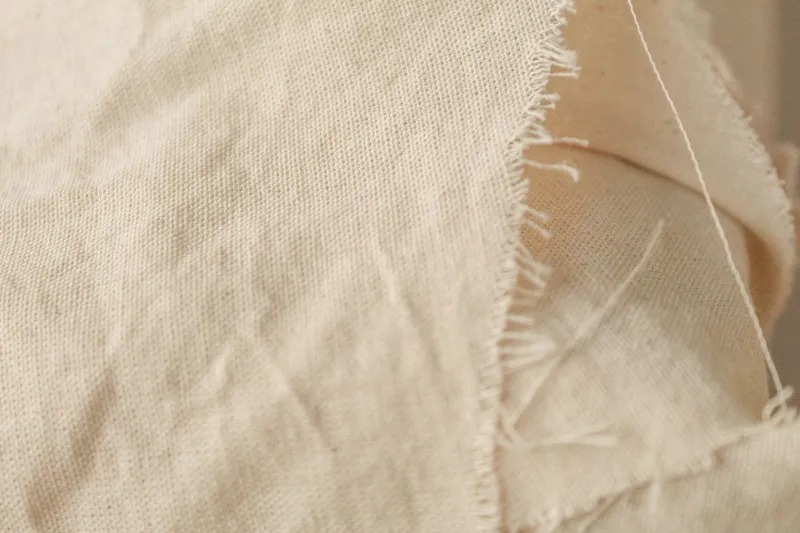
Open-weave fabrics present a particularly sophisticated case. A loosely woven linen or an airy basketweave does not simply feel lighter than its denser counterpart—it reads differently. The eye perceives depth where there is technically none, because the interplay of thread and void creates a layered visual field. Worn over the body, these fabrics allow flesh tone or an underlayer to participate in the garment's overall composition. The designer is, in effect, working with two canvases simultaneously: the cloth itself and the space within it.
American sportswear has long flirted with this idea, from the perforated panels of athletic wear to the crochet-influenced resort collections that appear each spring. What distinguishes the most considered applications is intentionality. When open weaving is deployed to create visual rhythm or to soften an otherwise structured silhouette, it functions as a genuine design element. When it is applied as trend-driven surface decoration, the logic dissolves.
Negative Space in Print and Pattern
Perhaps the most underappreciated application of this principle occurs in the design of printed textiles. A print is not merely what is drawn; it is also the ground against which those marks are made. The ratio of motif to field, the distribution of visual weight across a length of cloth, the deliberate preservation of open areas within a repeating pattern—these decisions determine whether a print feels crowded and anxious or composed and self-assured.
Some of the most enduring textile designs in fashion history have succeeded precisely because their designers understood that the background was not neutral. It was active. An ivory ground with widely spaced botanical motifs communicates a different emotional register than the same motifs packed tightly together, even if the drawn elements are identical. The space between the marks is doing work. It is creating breath, establishing pace, and signaling to the wearer that the designer trusted the design enough not to oversaturate it.
This restraint is not easy to achieve. The instinct to fill—to add one more detail, one more element, one more layer of interest—is a persistent temptation in design. Resisting it in favor of strategic emptiness requires both confidence and a clear understanding of what the design is trying to say.
Reading Sophistication Through What Is Left Out
For American consumers increasingly fluent in the language of considered dressing, negative space has become a reliable signal of design intelligence. There is a reason that garments built on this principle tend to read as more expensive, more refined, and more enduring than their heavily embellished counterparts—even when the actual production costs are comparable. The eye understands, on some level, that restraint is harder to achieve than addition. Knowing what to leave out requires a more precise vision than knowing what to put in.
This is the deeper argument for negative space as a design philosophy: it is not about austerity for its own sake, nor is it a rejection of decoration as a category. It is about the discipline of intention. Every empty area in a well-designed garment is a choice. It says, with quiet authority, that the designer knew exactly what they were doing—and trusted the wearer to understand it.
In that exchange between designer and wearer, the silence speaks volumes. And in the most considered contemporary fashion, it is often the loudest voice in the room.