Drawn in Thread: The Hidden Logic of Seam Placement and Its Power Over Form
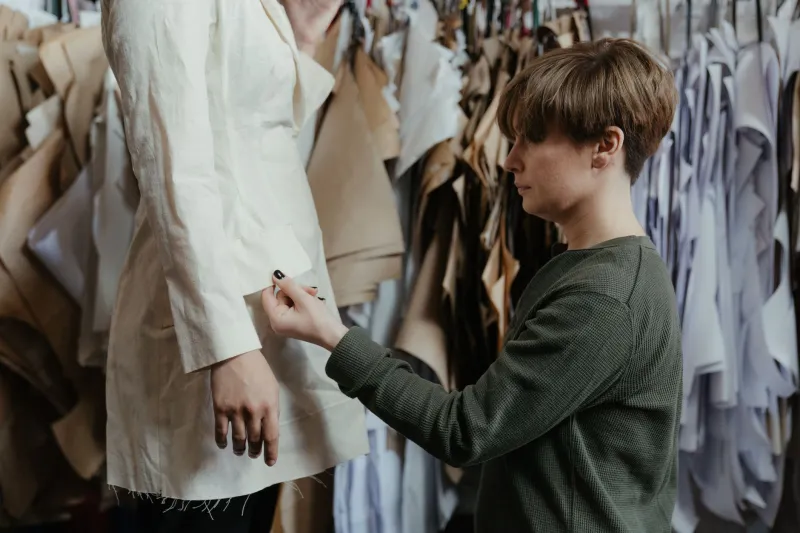
There is a moment, when studying a well-constructed garment up close, when the eye begins to notice what it previously overlooked. A seam that does not follow the expected path. A line that curves slightly where convention would have it run straight. A join that appears to migrate toward the body at an angle that defies the fabric's natural grain. These are not accidents. They are decisions — precise, deliberate, and quietly transformative.
Seam placement is among the most underestimated instruments available to a designer. In an era that celebrates the clean line and the unadorned surface, the seam functions as architecture: invisible to the casual observer, yet entirely responsible for how a garment holds its shape, flatters a body, and communicates its intent.
The Seam as Structural Argument
Conventional construction logic places seams at the edges of a pattern — at the side, the shoulder, the center back. These positions are practical and efficient. They allow fabric panels to be joined in the most direct path from point to point. But efficiency is not the same as intelligence.
Contemporary designers who work with seaming as a primary design element understand that the placement of a join carries visual weight. A seam is a line, and lines direct the eye. A vertical seam running through the front of a bodice elongates the torso. A curved seam that arcs away from the side body can simulate a narrowed waist without a single dart or gather. A diagonal seam across a skirt panel introduces implied movement — a sense that the garment is already in motion, even at rest.
This is not decoration. It is engineering expressed through aesthetics.
The Princess Seam, Revisited
Among the most instructive examples of structural seaming is the princess line — a construction technique that runs a seam from the shoulder or armhole continuously through the bust and down to the hem. In its classical form, it is the mechanism by which a fitted silhouette is achieved without relying on darts alone. But in the hands of a designer who treats seaming as a compositional tool, the princess line becomes something far more nuanced.
By shifting the seam's origin point — moving it from the shoulder to a lower position on the armhole, or redirecting its curve to pass closer to or farther from the bust apex — the designer can dramatically alter the perceived proportion of the body beneath. A line that curves outward before returning inward creates the illusion of fullness above and narrowness below. A line that runs more vertically through the chest reads as elongating. The garment does not change in volume; the eye changes in what it perceives.
This is the essential promise of seam strategy: it creates visual transformation without material addition.
Hidden Construction and the Art of the Invisible Seam
Not all structural seaming is meant to be seen. Some of the most sophisticated work in contemporary fashion design takes place in the interior of a garment — in the unseen layers that give a piece its memory, its posture, its resistance to collapse.
Underlining, boning channels, and internal tape stays are techniques borrowed from couture tradition but adapted continuously for modern production. A narrow stay sewn along the inner edge of a neckline prevents it from falling forward. A strip of interfacing fused along an unconventional seam allowance can lock a panel into a precise angle that the fabric would not hold on its own. These interventions are invisible by design, and their invisibility is the point — they allow the exterior of a garment to read as effortless precisely because the effort has been absorbed into the structure beneath.
At Joan Design, this philosophy of concealed engineering aligns directly with our broader commitment to refined minimalism. A surface that appears simple should not be confused with a garment that was simple to produce. Quite often, the reverse is true.
Seaming and the Body in Motion
A garment is not experienced on a hanger. It is experienced on a body that walks, reaches, sits, and turns. Seam placement that ignores movement is seam placement that will fail under real conditions — pulling at the wrong moment, distorting a line when a shoulder lifts, or creating drag across the back when the wearer leans forward.
This is why the most thoughtful designers consider seaming in three dimensions from the earliest stages of development. A seam placed at the back of an armhole rather than the traditional side position can allow the sleeve to rotate forward naturally as the arm extends — eliminating the binding sensation that plagues conventionally constructed jackets. A curved seam at the upper thigh of a trouser can distribute ease more naturally across the hip, allowing the leg line to remain clean without sacrificing comfort.
The relationship between seaming strategy and wearability is not incidental. It is, in fact, one of the primary arguments for investing deeply in construction knowledge — because a garment that moves beautifully communicates something that no surface treatment can replicate.
Reading a Garment's Lines
For those who wish to develop a more discerning eye for construction, seam placement offers an ideal starting point. The next time a garment commands attention — whether on a rack, a runway image, or a well-dressed figure across a room — it is worth asking where the seams fall, and why.
Does a side seam sit slightly forward of the true side body, narrowing the back silhouette? Does a shoulder seam migrate toward the back, creating a cleaner line from the front? Does a curved seam on a coat's chest panel describe a gentle arc that mirrors the geometry of the collarbone? These are not arbitrary choices. They are the product of a designer's sustained conversation with the body and with fabric — a conversation conducted in the language of line, tension, and proportion.
The Discipline Behind the Silence
What distinguishes seaming as a design philosophy from seaming as mere construction is intentionality. A seam placed because it must exist is functional. A seam placed where it creates the most precise visual and structural effect is authorial.
This distinction matters deeply to how we approach our work at Joan Design. The garments we value most — both in our own collections and in the broader landscape of contemporary fashion — are those in which every line has been questioned, tested, and ultimately justified by what it contributes to the whole. Not every seam will be visible. Not every structural choice will be legible to the wearer. But the cumulative effect of those decisions is felt in how a piece sits, moves, and endures.
Silhouette, in this sense, is never simply the result of cutting fabric to a shape. It is the result of understanding where to draw the lines — and what those lines, placed precisely, will ask the eye to believe.