The Art of Letting Go: How Subtraction Becomes a Designer's Most Powerful Creative Tool

The Sketch Is Only the Beginning
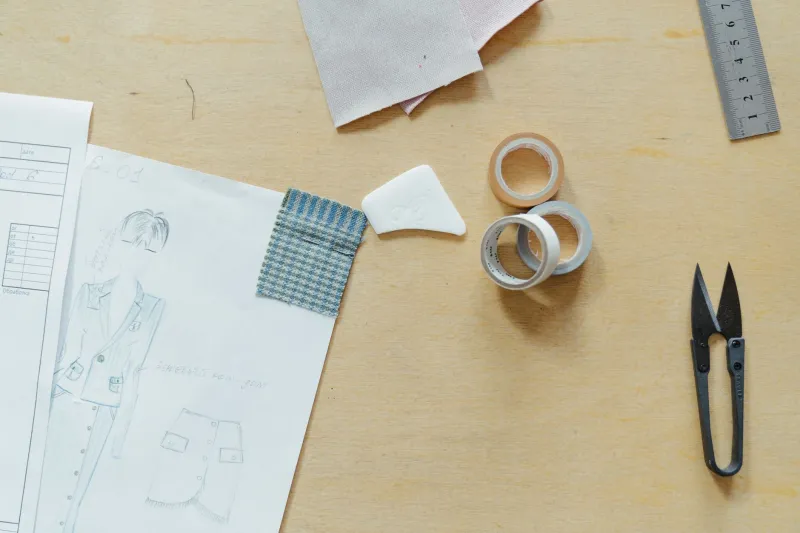
There is a particular kind of confidence required to draw freely — to fill pages with silhouettes, proportion studies, and detail explorations without self-censorship. Most design education celebrates this phase. Studios are organized around it. Mood boards are assembled for it. And yet, the designers whose work endures season after season will quietly acknowledge that the sketch studio, for all its creative energy, is not where their best decisions are made.
Those decisions happen later. They happen when the initial enthusiasm has cooled and the collection, spread across a sample rack or pinned to a wall, must be interrogated rather than admired. They happen in what might be called the editing room — that stage of the process where the work of subtraction begins in earnest.
This is not a comfortable stage. It requires a designer to look at something they created, something they believed in enough to develop into a physical sample, and ask whether it truly belongs. Often, the honest answer is no.
Why the Brain Resists Editing
Cognitive scientists have long studied what is sometimes called the escalation of commitment — the human tendency to continue investing in something simply because investment has already been made. In design, this phenomenon manifests as an attachment to ideas that cost significant time and creative energy to develop. A construction detail that required three pattern iterations. A collar that consumed two weeks of draping work. These elements accumulate a kind of sentimental weight that has nothing to do with whether they strengthen the final garment.
The forgetting curve — a concept drawn from memory research, describing how information fades without reinforcement — offers a useful analogy for the design process. When a designer steps away from a collection and returns to it with fresh eyes, the ideas that survive that distance are typically the ones worth keeping. The rest, the details that seemed essential in the moment of conception but lose their logic in the light of a later morning, reveal themselves as noise.
Strategic forgetting, in this sense, is not a failure of memory. It is a discipline. It is the practiced ability to release attachment to an idea in the service of the work's larger coherence.
The Case Studies That Argue for Restraint
Contemporary designers working within the American market have begun speaking more openly about the editorial phase of their process, and their accounts share a common thread. The collections that generated the most critical attention and the most loyal customer response were, almost without exception, the most reduced ones.
One New York-based womenswear designer described the development of her third collection as a process of deliberate dismantling. She had entered the editing phase with forty-two looks and a clear aesthetic vision. By the time the collection was finalized, it contained twenty-three. The nineteen looks that were cut were not failures — several were technically accomplished. But they were, in her assessment, redundant. They said something the remaining pieces had already said more clearly.
"When you remove something and the collection gets stronger, that tells you more about design than any addition ever could," she noted during a conversation about her process. "The piece that was cut wasn't wrong. It was just unnecessary. And unnecessary is its own kind of wrong."
This sentiment surfaces repeatedly among designers who have developed a mature editing practice. The issue is rarely quality. It is proportion — the relationship between how much is being said and how much the audience can receive.
Constraints as Creative Architecture
There is a related principle at work in the design philosophies of studios that intentionally impose constraints before the sketching process begins. Rather than waiting to edit at the end, these designers build limitations into the project from its inception. A palette of three colors. A single fabric family. A silhouette vocabulary restricted to two or three foundational shapes.
The counterintuitive result is not creative limitation — it is creative concentration. When the available territory is smaller, the decisions made within it carry more weight. A single seam placement becomes a statement. A hem length becomes an argument. Details that would disappear in a more crowded collection become legible, even iconic.
This is the paradox that experienced designers learn to trust: constraints do not diminish work. They clarify it. They force the designer to commit rather than hedge, to choose rather than accumulate.
The Emotional Labor of Subtraction
For all its creative logic, editing remains emotionally demanding work. The design process involves genuine investment — not merely time and technical skill, but something closer to belief. A designer who brings a concept to the sample stage has, in some sense, argued for that concept through every stage of its development. Walking away from it requires reversing that argument.
This is why the editing room benefits from distance — both temporal and psychological. Many designers report that the most effective editing sessions happen after a deliberate break from the work, when the emotional investment has diminished enough to allow honest assessment. Others bring in trusted collaborators specifically for the editing phase, relying on someone who did not participate in the work's creation to ask the questions that attachment makes difficult.
The goal, in either case, is the same: to see the collection as the eventual wearer will see it. Not as a record of the effort that produced it, but as a set of objects that must justify their own existence.
What Survives the Cut
The pieces that emerge from a rigorous editing process share a particular quality. They feel inevitable — as though no other version of them could exist. This is not accidental. The editing process, at its best, does not simply remove what is weak. It reveals what is essential.
A garment that has survived the editing room has been tested against alternatives and found to be the clearest expression of the idea it represents. It carries none of the uncertainty of the sketch phase, none of the hedging that comes from working in an open field of possibility. It has been chosen, deliberately, over everything that was considered and set aside.
That choice is visible. Wearers may not be able to articulate it, but they register it. The coherence of a well-edited collection communicates something to the person who encounters it — a sense that the designer knew exactly what they were doing, and more importantly, exactly what they were not doing.
In contemporary fashion, where the volume of visual information is relentless and the competition for attention is fierce, that clarity is not merely an aesthetic preference. It is a competitive advantage. The designers who have learned to edit ruthlessly are, in the end, the ones whose work is most remembered — precisely because they had the discipline to forget.