Designing With the Body in Mind: How Pattern-Making Is Returning to Human Proportion

For decades, the prevailing logic of fashion operated on a simple, if quietly authoritarian, premise: the body adapts to the garment. Seasonal silhouettes arrived with the authority of mandates — nipped waists, exaggerated shoulders, dropped hems — and the implicit expectation was that the wearer would find a way to fit the vision. What is emerging now among a thoughtful cadre of contemporary designers is something fundamentally different: a design practice that begins not with a trend board, but with the structural reality of the human form.
This is not merely a stylistic preference. It represents a philosophical reorientation — one that treats the body's natural proportions as a starting point worthy of deep technical engagement rather than an obstacle to be overcome.
The Tyranny of the Trend Silhouette
To understand why this shift matters, it helps to examine what came before it. The fashion industry has long organized itself around the concept of the seasonal silhouette — a dominant shape that defines a given collection's visual identity and, by extension, the era's aesthetic conversation. There is genuine creative value in this tradition. Silhouettes communicate cultural mood, challenge visual expectations, and give designers a shared vocabulary.
The problem arises when silhouette becomes prescription rather than inspiration. When a particular shape is treated as universally desirable regardless of who is wearing it, the garment stops functioning as clothing and begins functioning as costume. The wearer is asked to disappear into a shape that was never designed with their specific frame in mind.
American consumers, in particular, have grown increasingly resistant to this arrangement. A culture that has steadily expanded its vocabulary around body diversity and individual expression is, unsurprisingly, less willing to accept that a single seasonal shape should determine how everyone dresses. The demand for clothing that actually fits — not just in the technical sense of covering the body, but in the deeper sense of complementing it — has never been more clearly articulated.
Proportion as a Design Tool
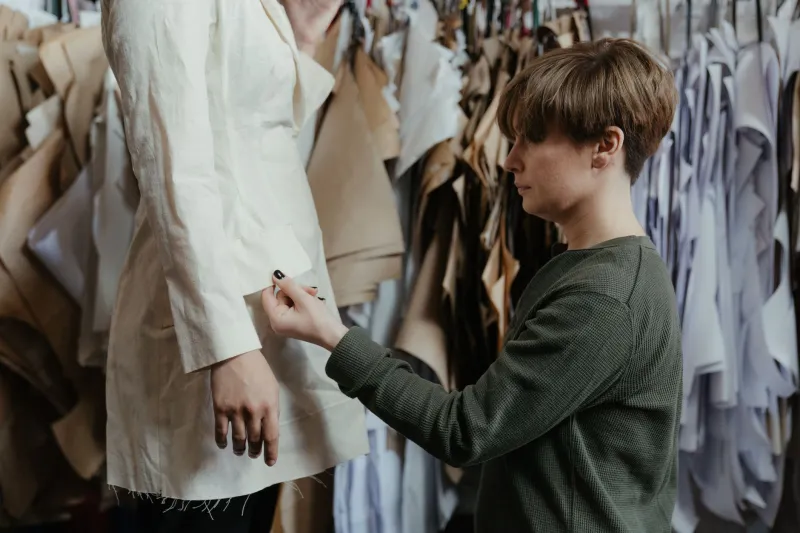
What distinguishes the designers leading this shift is their willingness to treat proportion as a primary design variable rather than a secondary concern addressed in the fitting room. The work begins at the pattern-making stage, where decisions about dart placement, seam angles, and ease allowances quietly determine how a finished garment will interact with a given body type.
Traditional pattern drafting often works from an idealized standard measurement chart — a useful shorthand, but one that flattens the enormous variation in how real bodies are actually proportioned. A person might carry most of their height in their torso, or have shoulders that sit narrower than their hip measurement would suggest, or have arms that fall longer relative to their frame than standard sizing accounts for. These are not anomalies. They are simply the natural range of human architecture.
Designers who prioritize proportional intelligence are building this range into their work from the beginning. They are drafting patterns with adjustable structural elements — seams positioned to allow lengthening or shortening without disrupting the garment's overall geometry, shoulder constructions that can shift slightly without collapsing the sleeve line, bodice proportions that maintain their visual balance across a wider range of torso lengths. The technical vocabulary is intricate, but the goal is elegantly simple: a garment that looks considered on the body wearing it, not on a hypothetical body it was designed for.
The Engineering Behind Adaptability
One of the more sophisticated expressions of this philosophy lies in what might be called structural versatility — the deliberate engineering of garments to read differently on different frames without losing their essential character. This is considerably harder to achieve than it sounds.
A wrap silhouette, for instance, is often cited as universally flattering, but that reputation rests on specific construction choices: the angle of the wrap, the placement of the tie, the weight and drape of the fabric. Alter any one of these variables carelessly and the garment that works beautifully on one body type becomes awkward on another. The designers doing this work thoughtfully are studying these relationships systematically — testing the same pattern across a genuine range of fit models, observing where the garment succeeds and where it struggles, and refining accordingly.
Fabric selection plays an equally significant role. A material with generous drape will behave very differently across varying body volumes than a fabric with structural rigidity. Designers committed to proportional intelligence are making these material choices in direct conversation with their pattern decisions, understanding that the two are inseparable. The cloth does not merely cover the pattern — it interprets it.
A Return to Dressmaking Logic
There is something historically resonant about this direction. The great dressmakers of the mid-twentieth century — figures whose names remain shorthand for enduring elegance — built their reputations on an intimate understanding of individual body architecture. Couture, at its finest, was always a dialogue between maker and wearer, with the garment serving as the medium of that exchange.
What contemporary designers are doing is not a nostalgic recreation of that tradition, but a translation of its underlying logic into modern practice. The tools are different — digital pattern-making software, body-scanning technology, expanded access to global fabric markets — but the animating principle is the same: the body is not a problem to be solved. It is the starting condition from which every design decision must flow.
For American consumers navigating an increasingly crowded marketplace, this distinction matters. It is the difference between purchasing a garment that happens to fit and purchasing one that was designed, in some meaningful sense, for bodies like yours.
What This Means for the Contemporary Wardrobe
The practical implications of this shift are worth considering carefully. Clothing designed with proportional intelligence tends to perform differently over time. Because the garment's visual balance does not depend on the wearer conforming to a specific silhouette, it retains its sense of intention across different styling contexts. It can be layered, belted, or worn simply without losing its structural coherence. It works not because it imposes a shape, but because it responds to one.
This is, ultimately, what it means for a garment to be well designed in the fullest sense of the phrase — not merely well made, not merely visually compelling, but genuinely in service of the person wearing it. The body's natural architecture is not a limitation. In the hands of a designer willing to truly engage with it, it is the most generative starting point available.