Proportion as Poetry: How Contemporary Designers Engineer the Perfect Fit
There is a quiet mathematics at work in every well-made garment. It operates beneath the surface of fabric and seam, invisible to the casual eye yet immediately felt by the body wearing it. This is the geometry of proportion—the careful calibration of spatial relationships that separates clothing that merely covers from clothing that genuinely flatters.
At Joan Design, proportion is not a secondary consideration. It is, in many respects, the primary language of design itself.
Beyond the Tag: Why Size Is the Wrong Conversation
For decades, American fashion has organized itself around a sizing system that was, at its foundation, built on a remarkably narrow set of body measurements. The result is a culture in which shoppers routinely blame themselves when a garment fails to fit—when, in truth, the garment was never engineered with their particular proportions in mind.
Contemporary designers are beginning to dismantle this framework. Rather than asking what size a person wears, the more meaningful question is: what are the proportional relationships unique to this body, and how should a garment respond to them?
Shoulder width relative to hip circumference. Torso length relative to leg inseam. The distance between the natural waist and the fullest point of the hip. These ratios, not numerical sizes, are the true coordinates of fit.
The Shoulder Anchor: Where Proportion Begins
If there is a single structural element that determines whether a garment succeeds or fails proportionally, it is the shoulder seam. Designers who understand this treat the shoulder as an anchor point—the fixed reference from which all other measurements radiate.
When a shoulder seam sits precisely at the edge of the natural shoulder, it creates a visual line that aligns the entire upper body. Sleeves fall cleanly. The chest panel lies flat. The neckline holds its intended shape. Shift that seam even a half-inch in either direction, and the entire silhouette begins to dissolve.
This is why off-the-rack garments so frequently disappoint. Manufacturers standardize shoulder width across size runs in ways that cannot accommodate the genuine diversity of human anatomy. A person with broader shoulders relative to their chest, or narrower shoulders relative to their hip width, will find that the cascade of proportional errors begins at that seam and travels downward through the entire garment.
For this reason, skilled designers often recommend that alterations begin at the shoulder—even when a client believes the issue lies elsewhere.
Sleeve Length and the Art of the Arm
Few proportional details communicate design sophistication as immediately as sleeve length. And yet it is among the most frequently overlooked.
The classical rule—that a jacket or blazer sleeve should reveal approximately a quarter to a half inch of shirt cuff—exists not as arbitrary convention but as a proportional principle. That small reveal elongates the arm visually, creates a layered sense of depth, and signals that the garment was made with deliberate attention to the wearer's body.
Beyond formalwear, sleeve length carries enormous expressive power in contemporary design. A slightly shortened sleeve on a structured coat draws attention to the wrist and hand, creating an effect of lightness. An intentionally extended sleeve on a relaxed knit creates a sense of ease and volume. Neither is accidental in the hands of a thoughtful designer. Both are proportional decisions made in service of a specific aesthetic and emotional outcome.
Hem Placement: The Line That Defines the Body
Perhaps no single design decision more dramatically affects the perceived proportion of the human figure than hem placement. The horizontal line created by a hem's edge acts as a visual stop—it is where the eye rests, and therefore where the viewer's perception of the body is most strongly shaped.
A hem that falls at the widest point of the hip will visually emphasize that width. A hem that ends just above the knee creates a visual break that elongates the leg. A midi hem that hits mid-calf can either ground a silhouette with elegance or truncate the leg depending on the wearer's proportions and the garment's overall volume.
Contemporary designers approach hem placement not as a fixed measurement but as a variable calibrated to the garment's intended wearer and purpose. At Joan Design, this means considering how a hem interacts not only with the body but with the shoes, layers, and movement that complete the look.
Waist Definition and the Illusion of Structure
The relationship between the natural waist and the garment's waist suppression—or deliberate lack thereof—is another axis of proportional decision-making. Structured waist definition creates an hourglass relationship between the upper and lower body. A dropped waist elongates the torso and creates a different kind of visual rhythm. A straight-cut silhouette that entirely bypasses waist definition offers a third language: one of ease, modernity, and architectural simplicity.
None of these approaches is inherently superior. Each serves a different body, a different aesthetic, and a different emotional intention. What matters is that the choice is made consciously—that the designer understands the proportional conversation the garment is initiating and completes it with coherence.
Dressing the Diverse Body: Proportion as Equity
There is a deeper significance to proportional thinking that extends beyond aesthetics. When designers move away from size-based thinking and toward proportion-based design, they create a framework that can genuinely serve a wider range of bodies.
A garment engineered around proportional relationships—rather than standardized measurements—can be adapted, graded, and fitted across a far broader spectrum of body types without losing its essential character. The design remains intact. The silhouette holds. The intention of the work is preserved.
This is the promise of proportion-first design: that clothing can meet people where they are, rather than asking people to conform to where the industry has decided bodies should be.
The Designer's Eye as a Proportional Instrument
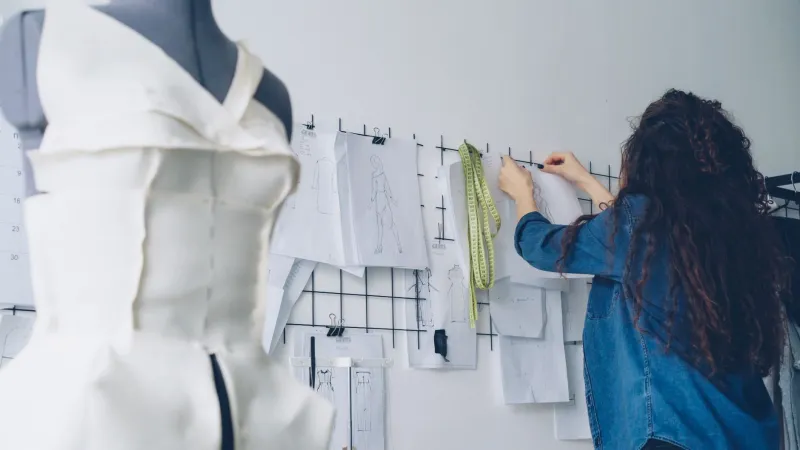
Ultimately, the geometry of fit is not purely mathematical. It is also deeply intuitive. Experienced designers develop what might be called a proportional eye—an ability to look at a draped form and sense immediately where the balance is off, where a seam should migrate, where additional ease would restore harmony.
This intuition is cultivated over years of observation, draping, fitting, and revision. It is one of the most sophisticated skills in the designer's repertoire, and it is the reason that truly excellent fit remains rare even in an era of advanced manufacturing.
At Joan Design, we believe that understanding proportion—even at a conceptual level—changes how people engage with clothing. It shifts the conversation from size to silhouette, from number to nuance. And it opens the door to a more honest, more generous, and more artful relationship between the body and what it wears.