Fit as Foundation: How Garment Architecture Quietly Rebuilds the Way You Carry Yourself
There is a particular moment that most people have experienced at least once: pulling on a garment and feeling, almost instantly, that something has shifted. The shoulders settle. The posture corrects itself without conscious effort. The mind quiets its usual self-inventory. That moment is not accidental. It is the result of deliberate design decisions made long before the fabric was ever cut—decisions about where a seam should fall, how much ease a bodice should carry, and what angle a shoulder line should follow to align with the body rather than impose upon it.
Fit, in the context of serious fashion design, is not simply about size. It is a structural discipline. And increasingly, contemporary American designers are treating it as the most consequential tool in the creative process.
The Architecture Beneath the Aesthetic
Most conversations about clothing center on what is visible: color, silhouette, fabrication. Fit operates differently. It belongs to the invisible layer of design—the set of technical choices that determine how a garment behaves in motion, how it distributes pressure across the body, and how it communicates shape without announcing it.
Pattern-making is the discipline that governs these decisions. A trained pattern-maker does not simply draft a flat template from standard measurements. They account for the body's three-dimensionality: the way a shoulder rotates forward during movement, the curvature of the lumbar spine, the asymmetrical nature of most human torsos. When these variables are addressed with precision, the resulting garment does not fight the body. It moves with it.
This distinction—between clothing that accommodates the body and clothing that collaborates with it—is where confidence enters the equation. A garment that resists natural movement creates low-level physical tension that the wearer carries throughout the day. One that anticipates movement removes that friction entirely, leaving the wearer free to occupy their body without negotiation.
Strategic Ease and the Psychology of Room
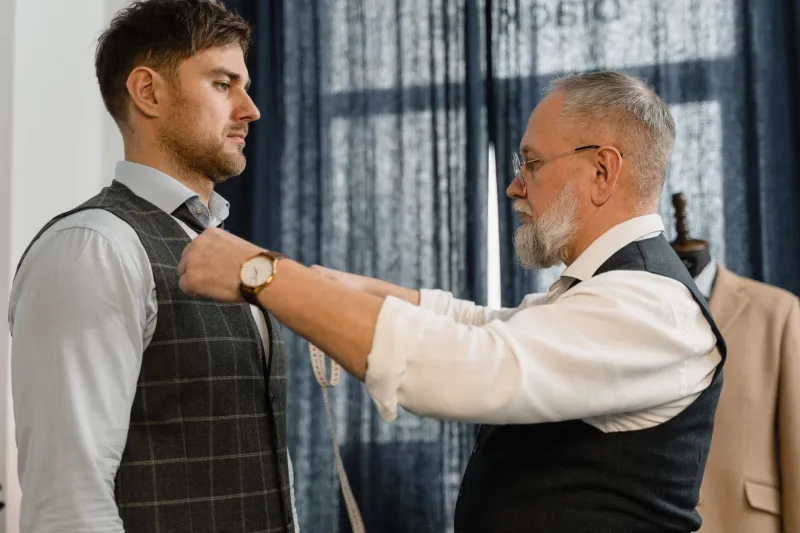
In technical tailoring, ease refers to the amount of space built into a garment beyond the body's actual measurements. It is the breathing room between skin and fabric. Ease is not looseness—it is calculated generosity, applied with intention at specific points of the body to allow for comfort, mobility, and a particular quality of drape.
The psychology of ease is more complex than it first appears. Too little ease, and a garment reads as restrictive, drawing constant attention to the body's movement and creating a kind of physical self-consciousness. Too much, and structure collapses, leaving the wearer shapeless in a way that can feel equally uncomfortable. The calibration of ease—knowing precisely where to add volume and where to remove it—is among the most refined skills in contemporary design.
Designers who understand ease as a psychological tool, not merely a technical specification, use it to create garments that feel protective without feeling confining. A jacket with generous ease through the upper back and precisely fitted sleeves, for example, creates a silhouette that reads as composed and intentional while allowing the wearer to move freely. That combination—structure where the eye expects it, freedom where the body needs it—produces a wearing experience that is quietly empowering.
Seam Placement as a Confidence Variable
Where seams are placed on a garment is among the most underappreciated decisions in the design process. Seams are not merely functional junctions where fabric panels are joined. They are lines that the eye follows, contours that suggest shape, and structural anchors that determine how a garment holds its form throughout the day.
A princess seam running vertically from shoulder to hem, for instance, does more than shape a bodice. It creates a visual line that elongates the torso and draws the eye upward, producing a sense of height and proportion that affects how the wearer is perceived—and, consequently, how they perceive themselves. Side seams positioned slightly toward the back of the body rather than at the true side can make the front panel appear broader and more commanding, a subtle adjustment with a measurable effect on presence.
Contemporary designers working in this space think about seam placement the way an architect thinks about load-bearing walls: not just as structural necessity, but as a means of shaping experience from the inside out.
The Tailoring Revival and Its American Moment
Across American fashion culture, there has been a quiet but significant return to the values of bespoke tailoring—not necessarily in the form of made-to-measure garments, but in the expectation that ready-to-wear should perform with similar attentiveness to individual proportion. Consumers are becoming more articulate about fit, more willing to invest in alterations, and more drawn to brands that treat garment construction as a form of respect for the wearer's body.
This shift reflects a broader cultural conversation about clothing as self-expression rather than self-concealment. When a garment fits well, it does not demand attention. It simply allows the person wearing it to be present—to move through a meeting, a dinner, or a city street without the low hum of physical discomfort or aesthetic uncertainty that ill-fitting clothing so reliably produces.
The designers responding most thoughtfully to this moment are those who approach fit not as a constraint to be managed but as a language to be mastered. They recognize that a garment's relationship to the body is its most honest communication—more telling than any print, embellishment, or silhouette choice.
Designing for Assurance, Not Aspiration
Perhaps the most meaningful shift in contemporary fit philosophy is the move away from aspirational sizing—the idea that clothing should reflect an idealized body rather than the actual one—toward what might be called assurance-based design. This approach begins with the body as it exists, not as it might be imagined, and works outward from that reality.
Assurance-based fit design prioritizes wearability over spectacle. It asks not how a garment looks on a static figure, but how it performs across the full range of a person's daily existence. Does it allow a full breath? Does it maintain its structure after four hours of wear? Does it accommodate the natural asymmetries that most bodies carry?
When these questions are answered well, the result is clothing that functions as a form of infrastructure—invisible in the best possible sense, present only in the confidence it quietly enables. That is the true ambition of fit architecture: not to transform the body, but to make the body feel entirely at home within itself.
At Joan Design, this principle sits at the center of how we think about contemporary clothing. Every seam, every ease allowance, every structural decision is made in service of the person who will ultimately wear the work—because design that does not account for the human being it dresses is, in the end, design that has missed its most essential point.