Drawn in Air: The Transformative Role of Negative Space in Contemporary Ready-to-Wear
There is a particular kind of confidence required to leave something unfinished. In architecture, a well-placed void draws the eye as powerfully as any column or cornice. In music, the rest between notes gives rhythm its meaning. Fashion, at its most considered, operates by precisely the same logic — and the designers who understand this are reshaping what it means to dress with intention.
Negative space in clothing is not a new concept, but its application within contemporary ready-to-wear has grown increasingly sophisticated. Where once an open construction might have signaled incompletion or trend-chasing, today it signals the opposite: mastery, restraint, and a deep understanding of the body as a visual subject.
What Negative Space Actually Means in Clothing Design
At its most fundamental, negative space refers to the unoccupied areas within or around a garment — the cutout at a shoulder seam, the asymmetrical hem that leaves one leg exposed, the deliberate gap where two panels almost but do not quite meet. These are not accidents or afterthoughts. They are architectural decisions made with the same precision a sculptor applies when removing material from stone.
In ready-to-wear, the challenge is translating this principle into pieces that function in daily American life — garments that must survive a morning commute, a client meeting, or a weekend afternoon without losing their visual coherence. This is where the discipline truly reveals itself. A cutout placed carelessly reads as costume. A cutout placed with geometric intention reads as design.
The distinction lies in proportion, context, and structural logic. When a designer opens a seam along the lateral torso, for instance, the negative space created does not simply expose skin — it redefines the silhouette's relationship to light and movement. The garment becomes dimensional in a way that surface embellishment never achieves.
The Psychology of What Is Not There
Human perception is drawn instinctively toward contrast and incompletion. The brain works to resolve visual gaps, which means a garment built around absence commands sustained attention in a way that a fully covered silhouette often does not. This is not manipulation — it is an understanding of how the eye moves and what the mind finds compelling.
When a blouse features a single asymmetrical cutout at the collarbone rather than a conventional neckline, the viewer's gaze is directed rather than scattered. The negative space acts as punctuation — a comma that slows the eye before moving it along the intended visual path. The result is a garment that feels edited, considered, and quietly authoritative.
For the American consumer who has grown weary of maximalist dressing but still craves visual interest, this quality is particularly resonant. Negative space offers sophistication without ornamentation, personality without noise. It satisfies the desire to be noticed without demanding to be looked at.
Strategic Cutouts: More Than a Trend
Cutouts have cycled through fashion's vocabulary many times, but their current iteration is markedly different from the exposed-midriff moment of a decade ago. Contemporary designers are applying cutout construction with an almost architectural rigor — using the openings to create proportion illusions, to interrupt a silhouette's predictability, or to draw attention to a specific point of the body with the precision of a spotlight.
A single oval excision at the upper back of an otherwise minimal sheath dress does more visual work than any surface print. It introduces shadow, movement, and a subtle asymmetry that makes the garment feel alive. More importantly, it accomplishes this without adding weight, cost, or complexity to the construction in a way that compromises wearability.
This is the commercial genius embedded in the philosophy: negative space is, by definition, economical. The material is not there. What replaces it — the interplay of light, skin, and structure — costs nothing to produce and everything to conceive correctly.
Asymmetrical Hems and the Art of Directed Attention
Few design decisions communicate intent as immediately as the hemline. A symmetrical hem implies resolution, completion, a full stop. An asymmetrical hem creates movement — it implies continuation, suggests a story still unfolding. When used deliberately, it is among the most elegant tools in a contemporary designer's vocabulary.
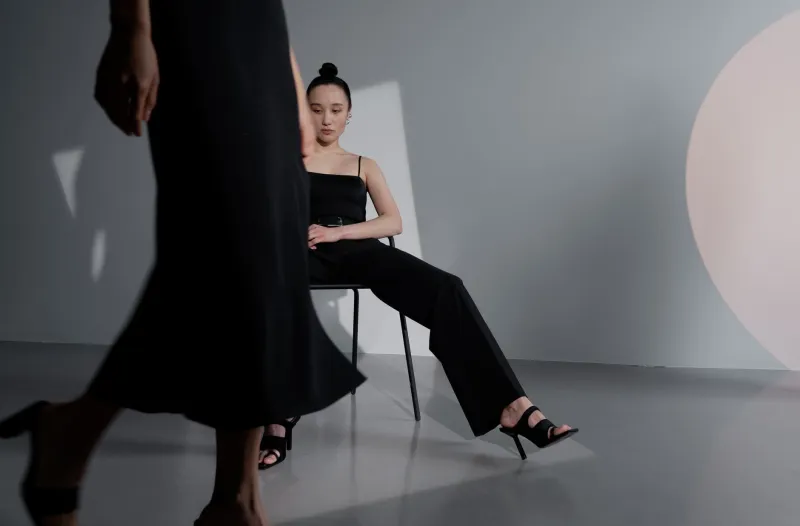
The asymmetrical hem functions as negative space not because it removes material from the garment's surface, but because it creates an absence at the boundary between clothing and body. The exposed leg, the angled sweep of fabric across the shin, the dramatic diagonal from hip to floor — each of these constructions opens a visual gap that the eye naturally fills with the line of the wearer's form.
This is where ready-to-wear intersects most directly with wearable art. The garment and the body become collaborators. The designer has created not a finished object but a framework within which the wearer's own silhouette completes the composition. That collaborative quality — the sense that the piece is designed for a living, moving subject rather than a static display — is precisely what separates design from mere production.
Open Construction and the Refined Unfinished Edge
Beyond cutouts and hems, some of the most compelling negative space in contemporary fashion is found in open construction — seams that do not fully close, panels that overlap without joining, facings that reveal the interior architecture of a garment. These choices carry an inherent risk: without precise execution, they read as incomplete or poorly made.
When executed with discipline, however, they communicate something rare in mass-market American fashion — transparency. Not in the literal sense, but in the sense that the garment is honest about its own structure. The viewer can see how it was made, where it begins and ends, and how the designer chose to resolve — or deliberately not resolve — its boundaries.
This honesty has a particular appeal for the contemporary consumer who has become increasingly attentive to how things are made. Open construction is not simply a visual choice; it is a philosophical one. It says that the process is as worthy of attention as the product.
Wearing the Void With Confidence
The practical question for any wearer considering a garment built around negative space is one of confidence rather than comfort. These pieces do not ask for bold accessories or elaborate styling — in fact, they resist it. A cutout shoulder blouse paired with a statement necklace creates visual competition that cancels both out. Negative space demands a certain editorial restraint from the person wearing it.
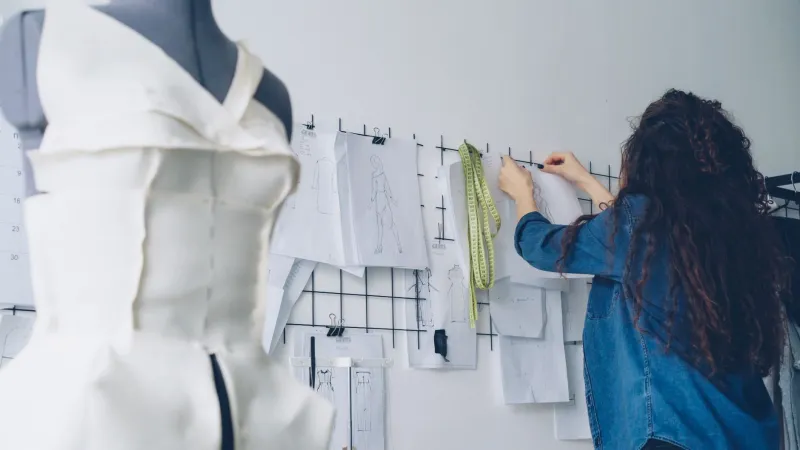
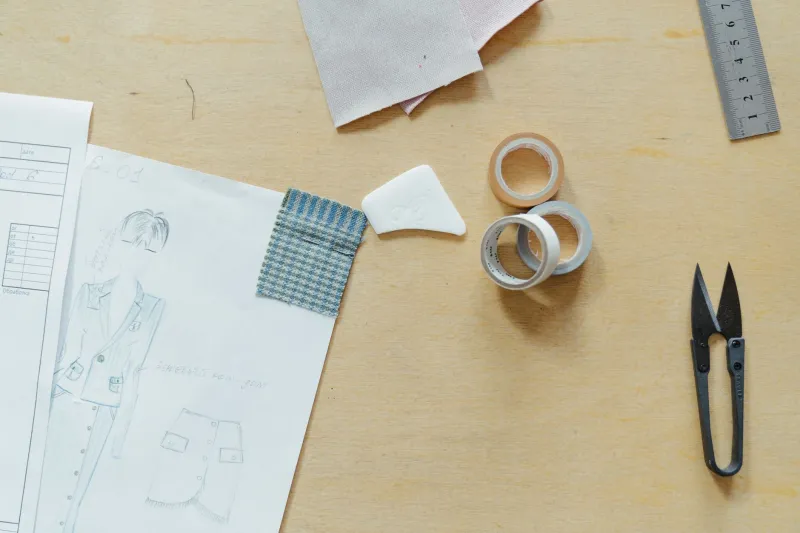
This is, ultimately, its most refined quality. A garment that uses absence as its primary language asks the wearer to trust the design — to believe that what is not there is doing as much work as what is. That trust, when honored, produces a kind of dressing that feels genuinely effortless: not because no thought was applied, but because all the thought was applied at the source, in the studio, before the first pattern piece was ever cut.
At Joan Design, this is precisely the standard we hold our work to. The silence between silhouettes is not empty. It is where the most considered design lives.