The Rotating Wardrobe: Building a Closet That Evolves With Intention
There is a moment that arrives, reliably, at the turn of each season. The light changes. The air shifts. And the closet, suddenly, feels wrong—overfull and yet somehow empty of the right things. For many Americans, the instinctive response is to shop. To acquire. To add.
But there is another response, one rooted in design thinking rather than consumer habit: to edit.
Seasonal wardrobe rotation—the deliberate practice of cycling pieces in and out of active use as the calendar moves—is one of the most undervalued skills in personal style. It requires patience, self-knowledge, and a willingness to engage with clothing as a curated collection rather than an accumulation. The reward, however, is a closet that feels consistently coherent, a daily dressing experience that is calm rather than chaotic, and a relationship with clothing that deepens rather than depreciates over time.
Why the Always-Available Closet Fails
Modern American closets tend toward maximalism. Decades of fast fashion, sale-season impulse purchases, and the cultural equation of more with better have produced wardrobes that are, in many households, genuinely overwhelming. When every item is accessible at every moment, the closet ceases to function as a curated resource and becomes instead a source of decision fatigue.
Research in behavioral psychology has consistently shown that an excess of options does not increase satisfaction—it diminishes it. The same principle applies with particular force to the daily act of getting dressed. When confronted with a closet containing hundreds of items, many of which no longer serve the wearer's current life or aesthetic, the mind retreats into habit. The same five outfits are worn on rotation while the rest of the closet gathers dust.
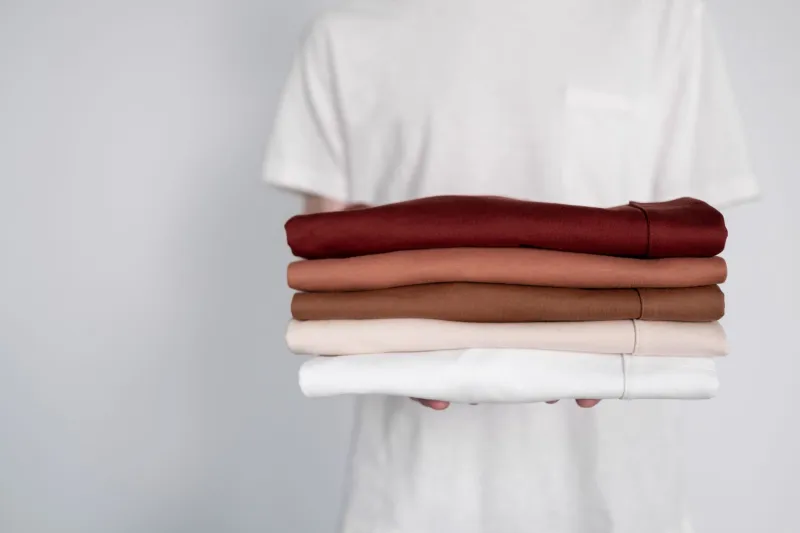
Seasonal rotation interrupts this pattern. By removing pieces from active circulation—storing winter coats when spring arrives, setting aside linen in October—the wardrobe that remains becomes smaller, more focused, and far easier to navigate. The pieces visible in the closet are, by definition, appropriate to the current moment.
The Edit as a Design Act
At its core, seasonal rotation is an act of editing. And editing, as any designer will attest, is where the real work of creation happens.
The initial impulse—to add, to accumulate, to keep options open—is easy. Restraint is harder. Deciding which pieces earn their place in the active wardrobe, and which should rest until their season returns, demands honest self-assessment and a clear sense of design language.
What is the visual and emotional logic of this wardrobe? Which pieces speak the same aesthetic dialect? Which ones feel like outliers—purchased in a moment of impulse or optimism but ultimately inconsistent with how this person actually dresses?
The seasonal transition is the natural moment to ask these questions. Pulling winter pieces from the closet in March is not merely a practical task. It is an opportunity to assess each item with fresh eyes, to notice which ones still feel relevant and which have quietly expired in terms of fit, condition, or alignment with the wearer's evolving sensibility.
Building the Seasonal Capsule
For those new to intentional rotation, the concept of the seasonal capsule offers a useful framework. Rather than managing a single vast wardrobe, the rotating closet is understood as a series of smaller, curated collections—one for each season—that share a common design language while responding to the specific demands of their moment.
A well-constructed seasonal capsule contains several categories of pieces:
Anchors are the structural garments that define the season's silhouette. In autumn, this might be a tailored wool coat. In summer, a clean linen shirt worn as a layering piece. These are the pieces that establish the visual tone of the season's wardrobe.
Workhorses are the high-frequency items that carry the majority of daily dressing: well-fitting trousers, versatile knitwear, reliable footwear. They should be chosen for their ability to function across multiple contexts and to pair easily with the other pieces in the capsule.
Accents are the pieces that introduce variation and personality—a printed scarf, a textured blazer, a color that punctuates an otherwise tonal wardrobe. Accents should be chosen sparingly, and they should be genuinely consistent with the season's color and texture story.
Bridges are the transitional pieces that can move between seasons—a lightweight cashmere cardigan that works in both spring and fall, or a versatile midi dress that reads differently depending on what it is layered over. Bridges are among the most valuable items in a rotating wardrobe because they extend the life and utility of each seasonal capsule.
The Psychology of Absence
One of the most counterintuitive benefits of seasonal rotation is the renewed appreciation it generates for pieces that have been resting. A coat stored carefully through spring and summer feels genuinely new when it reappears in October. The wearer encounters it with fresh eyes, notices its construction and quality anew, and is reminded of why it was worth keeping.
This is the psychology of absence at work. Scarcity—even self-imposed, temporary scarcity—restores perceived value. It is the same principle that makes a restaurant's seasonal menu feel more compelling than a year-round offering, or that gives a limited-edition collection its particular appeal.
By rotating pieces out of visibility, the thoughtful dresser effectively resets their relationship with those garments. The wardrobe does not grow stale because it is never seen all at once. Each seasonal reveal is, in its small way, a rediscovery.
Maintaining Design Coherence Across Seasons
For seasonal rotation to function as genuine style practice rather than mere storage management, it must be guided by a consistent design sensibility. The pieces that move in and out of active circulation should share a coherent aesthetic vocabulary—a common palette, a recurring relationship with silhouette, a consistent commitment to quality and craft.
This is where understanding design principles becomes practically valuable. A wardrobe built around tonal color stories, for instance, will rotate elegantly because pieces from different seasons can be layered and combined without visual conflict. A wardrobe organized around a consistent silhouette language—elongated proportions, say, or a preference for relaxed structure—will similarly maintain coherence even as individual pieces change.
The goal is a wardrobe that, at any point in the year, feels like a considered whole rather than a collection of separate purchases. Each season should feel like a chapter in the same story, not the opening of an entirely new book.
Rotation as Resistance
There is also a quiet cultural statement embedded in the practice of intentional rotation. In an era defined by relentless newness—by trend cycles that have compressed from seasons to weeks, by an industry that profits from perpetual acquisition—choosing to work deeply with what one already owns is an act of genuine resistance.
It is a declaration that clothing is worth sustained attention. That a well-made piece deserves to be worn across years, not discarded after a season. That style is cultivated through discernment, not accumulated through volume.
At Joan Design, we believe the rotating wardrobe is one of the most eloquent expressions of design appreciation available to the everyday dresser. It asks nothing more than attention—and in return, it offers a closet that is always, in every season, exactly enough.