The Case for Less: How Intentional Design Is Redefining American Fashion Value
For the better part of three decades, American fashion culture operated under a single, unchallenged premise: more is more. More options, more seasons, more turnover, more price points designed to make acquisition feel consequence-free. The machinery of fast fashion built an entire economy on the belief that clothing should be cheap, plentiful, and disposable — and for a time, that belief went largely unquestioned.
That time is passing.
Across the American fashion landscape, a quieter and considerably more considered movement is gaining momentum. It is not a movement defined by austerity or self-denial. It is defined, instead, by a growing understanding that genuine value in clothing — aesthetic, ethical, and personal — is found not in volume, but in the quality of what is made and how it endures.
What Fast Fashion Actually Cost Us
To understand why intentional design is resonating so powerfully now, it is worth examining what the alternative actually delivered. Fast fashion offered accessibility, and that accessibility was real. But the cost structure that made $12 blouses and $20 trousers possible was never truly borne by the consumer at the point of sale. It was distributed elsewhere — across underpaid labor, compromised materials, shortened garment lifespans, and an environmental toll that the industry is only beginning to reckon with honestly.
American consumers are increasingly aware of this ledger. A 2023 survey by the Fashion Institute of Technology found that over 60 percent of US consumers aged 25 to 45 reported placing greater importance on garment quality and brand ethics than they did five years prior. This is not a fringe sentiment. It is a mainstream recalibration, and it is reshaping how contemporary American designers approach their work.
The Design Philosophy of Restraint in Production
For contemporary designers committed to quality-driven practice, the decision to produce fewer pieces is not a limitation — it is a design principle. When a studio chooses to offer thirty considered garments rather than three hundred reactive ones, every decision within that collection carries more weight. The choice of fabric, the engineering of a seam, the proportion of a silhouette — each element receives the kind of attention that volume-based production structurally prevents.
This philosophy is evident in how thoughtful American brands approach material selection. Rather than sourcing fabrics based primarily on cost efficiency, quality-focused designers invest in textiles with demonstrable longevity: tightly woven wools that hold their structure across years of wear, organic cotton twills that soften rather than degrade, and technical fabrications selected for their performance across seasons rather than their novelty within one.
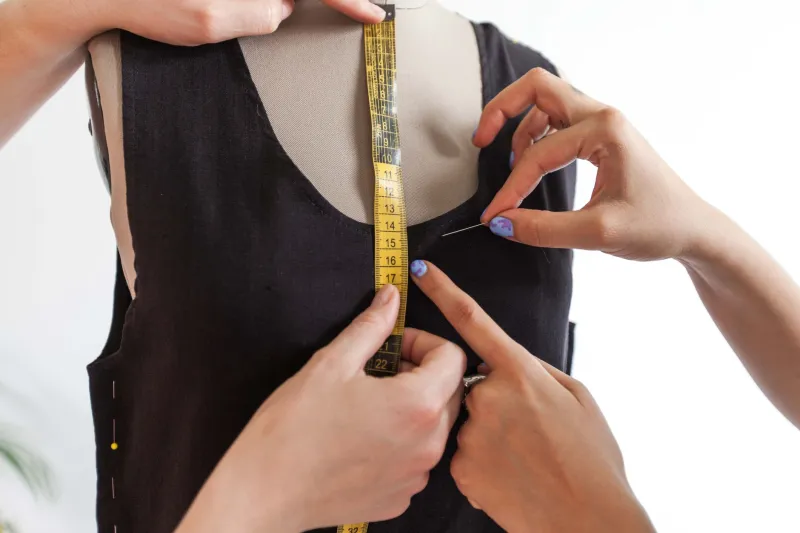
The construction methods that accompany these materials are equally deliberate. Flat-felled seams, hand-finished hems, and properly interfaced structures are not flourishes — they are the architectural decisions that determine whether a garment remains wearable and presentable after two years or two hundred washes. These are the details that fast fashion, by definition, cannot afford to include.
Timelessness as a Design Commitment
One of the most significant distinctions between volume-driven and quality-driven design is the relationship each has with time. Fast fashion is, by design, temporally bounded. Its garments are conceived to feel current for a single season and irrelevant shortly thereafter. This is not accidental — it is the mechanism by which the model sustains itself.
Contemporary designers working in opposition to this model make a fundamentally different commitment. They design for longevity — not in the sense of producing clothing that is deliberately staid or resistant to creative evolution, but in the sense that their garments are built to remain relevant because their underlying design language is sound. A beautifully cut wool coat from a quality-focused American studio does not become obsolete when the season changes. Its value is in its construction, its proportion, and its ability to function as a permanent element of a considered wardrobe.
At Joan Design, this approach to timelessness is central to how we think about design. A garment that earns a place in a wardrobe for years — rather than weeks — is one that has been designed with genuine respect for the person who will wear it.
The Consumer as Collaborator
The shift toward intentional consumption in American fashion is not solely a story about designers. It is equally a story about an evolving consumer — one who is increasingly willing to engage with clothing as a category that merits thoughtful consideration rather than impulsive acquisition.
This consumer understands, perhaps for the first time at scale, that the arithmetic of fashion value is not straightforward. A $350 wool trouser that remains structurally sound and aesthetically relevant for six years represents a meaningfully lower cost per wearing than a $40 equivalent that fades, pills, and loses its shape within a single season. The upfront investment is higher. The actual value, by almost any measure, is not.
Beyond economics, there is a values dimension to this shift that deserves direct acknowledgment. Choosing to invest in fewer, better-made garments is a statement about what one believes clothing should be and how it should be made. It is a vote, expressed through purchasing behavior, for labor practices that are ethical, for environmental footprints that are considered, and for a design culture that prizes craft over convenience.
Building a Wardrobe with Design Intelligence
For those seeking to align their wardrobes with these principles, the process begins with a simple but demanding question: does this garment earn its place? Not merely as something attractive in a fitting room, but as a piece that will continue to earn its place across seasons, across occasions, and across the natural evolution of personal style.
Approach acquisition with the patience that quality demands. A well-made garment from a considered designer is rarely available at the price point or on the timeline that fast fashion has conditioned us to expect. That friction is, in many ways, the point. It creates the space for genuine evaluation — of the garment's construction, its material integrity, and its relationship to what one already owns.
When fewer pieces are chosen with greater care, the wardrobe itself becomes a reflection of design thinking: edited, coherent, and built to last.
The Broader Significance
The movement toward quality-driven design and intentional consumption in American fashion is, at its core, a maturation. It represents a collective recognition that clothing — when approached with the seriousness it deserves — is one of the most intimate forms of design in daily life. What we choose to wear, how it is made, and how long we keep it are not trivial decisions. They are, in aggregate, a statement about what we value.
The designers and consumers who are reshaping American fashion around these principles are not simply choosing better clothes. They are choosing a more deliberate relationship with the objects that occupy their lives. That, ultimately, is what refined design has always been about.