Behind Every Seam: A Seven-Stage Journey Through the Professional Fashion Design Process
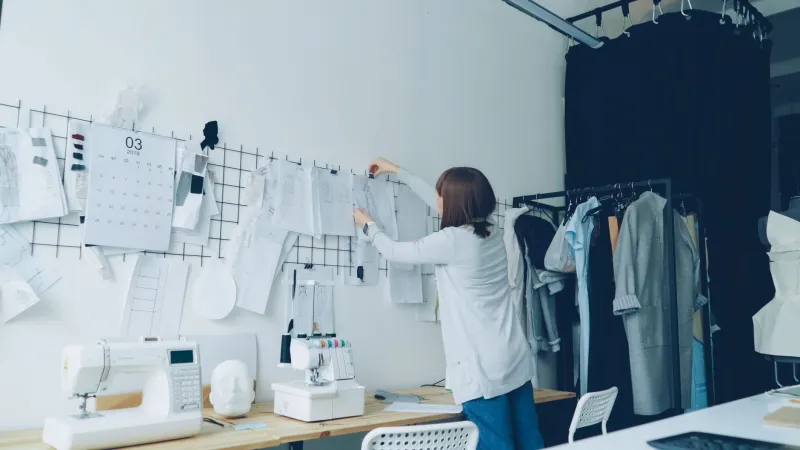
Most of us encounter fashion at the end of its story. We see the finished garment on a rack, on a runway, or on someone whose style we admire. We register color, silhouette, and texture. We decide, almost instantaneously, whether something speaks to us. What we rarely pause to consider is everything that had to happen before that moment of recognition—the months of research, the hundreds of sketches, the bolts of fabric evaluated and rejected, the prototypes that came apart at the seams before the right one came together.
At Joan Design, we believe that understanding the design process deepens the relationship between a person and the clothing they wear. A garment is not simply a product. It is a record of decisions, each one made in service of a vision. The following seven stages represent the professional pathway from idea to finished piece—and each one shapes the final result in ways that are both visible and invisible to the wearer.
Stage One: Research and Conceptual Inspiration
Every collection begins not with a pencil, but with a question. What feeling should this clothing evoke? What moment in culture, art, or lived experience does it respond to? Professional designers spend considerable time in this early phase—visiting museums, reading, traveling, observing the way people move through cities and spaces.
Inspiration for contemporary American designers can arrive from unexpected directions: the geometry of a brutalist building in Chicago, the color palette of a Georgia O'Keeffe painting, the texture of weathered denim in the American Southwest. The goal of this stage is not to collect images, but to develop a point of view—a coherent emotional and aesthetic premise that will anchor every subsequent decision.
At Joan Design, this conceptual foundation is the most protected part of the process. Everything else can be revised. The original question cannot.
Stage Two: Concept Sketching and Ideation
With a conceptual direction established, the designer moves to paper—or, increasingly, to digital tools that simulate the fluidity of hand-drawing. This stage is deliberately unfiltered. The goal is volume: dozens, sometimes hundreds of sketches that explore variations on a theme without yet committing to any single direction.
Concept sketches are not technical documents. They are visual thinking. A line that captures the sweep of a hem, a rough suggestion of a neckline, a note about proportion scrawled in the margin—these are the raw materials from which a collection begins to take shape. Designers look for the sketches that feel inevitable, the ones that seem to have arrived rather than been constructed.
This is the stage where creative instinct operates most freely, before the practical constraints of pattern-making and production enter the conversation.
Stage Three: Fabric and Material Selection
Fashion design is, at its most fundamental level, the art of working with material. The choice of fabric is not a secondary concern—it is a primary one. A silhouette that reads beautifully in a structured wool behaves entirely differently in a fluid silk charmeuse. The designer's vision and the fabric's properties must be in genuine dialogue.
Professional designers source fabrics from mills and suppliers across the country and around the world, evaluating not only aesthetic qualities—weight, drape, sheen, texture—but also practical ones: durability, care requirements, availability, and, increasingly, environmental impact. American consumers have grown more attentive to the provenance of their clothing, and responsible fabric sourcing has become both an ethical and a commercial consideration.
At this stage, a collection begins to acquire a physical reality. Swatches are pinned to mood boards. Colors are assessed under different lighting conditions. The relationship between fabric and concept is tested and, sometimes, revised.
Stage Four: Technical Drawing and Pattern Development
Once a design direction is confirmed and materials are selected, the work of translation begins. The expressive freedom of the concept sketch must be converted into the precise language of the technical drawing—a flat, dimensionless illustration that communicates exact proportions, seam placements, closures, and construction details to the pattern-maker.
Pattern-making is a discipline that combines mathematical precision with spatial intuition. A pattern is, essentially, a set of two-dimensional shapes that, when cut from fabric and assembled, will produce a three-dimensional form. Getting that translation right requires an understanding of how fabric moves, stretches, and responds to the body in motion.
This is one of the most technically demanding stages of the design process, and it is where the difference between a garment that fits beautifully and one that merely functions becomes apparent.
Stage Five: Toile and Prototype Construction
Before a garment is cut from the final fabric, it is typically constructed in a test material—traditionally a plain cotton muslin known as a toile. This prototype allows the designer and pattern-maker to evaluate the fit, silhouette, and construction of the piece without risking the cost of the finished material.
The toile fitting is a critical moment. A design that appeared resolved on paper may reveal unexpected problems in three dimensions: a collar that gaps, a shoulder seam that pulls, a hem that breaks at the wrong point. Adjustments are made, sometimes minor and sometimes significant, until the prototype achieves the intended effect.
For more complex designs—those involving structured tailoring, intricate draping, or unconventional construction—multiple rounds of prototyping may be necessary. This iterative process is not a sign of failure; it is the mechanism through which excellence is achieved.
Stage Six: Fit Review and Refinement
With a successful prototype in hand, the design moves into the fit review phase. This typically involves a fitting with a model whose measurements correspond to the collection's intended size range, allowing the designer to evaluate the garment in motion and under the conditions of actual wear.
The fit review is both a technical assessment and an aesthetic one. Is the silhouette reading as intended? Does the fabric behave as expected? Are the proportions correct relative to the body? Does the garment feel as good as it looks? These questions are answered collaboratively, with input from the designer, the pattern-maker, and sometimes the production team.
Refinements made at this stage are incorporated into the final pattern before production begins. The precision of this process is what separates well-designed clothing from clothing that simply exists.
Stage Seven: Production and Final Presentation
The final stage transforms a single refined prototype into a finished collection. In a professional design studio, this involves coordinating with production teams or manufacturing partners to ensure that each piece is executed consistently and to the standard established during development.
Quality control is an ongoing process throughout production, not a final checkpoint. Seams are examined, finishes are evaluated, and any deviation from the approved prototype is identified and corrected. The goal is not merely to replicate the prototype, but to honor it—to ensure that every garment that carries the label reflects the full intention of the design.
The collection then moves toward its presentation: whether a runway showing, a lookbook, a wholesale market appointment, or a direct-to-consumer launch. This is the moment when the private work of design becomes a public conversation—when the story that began with a question finally reaches the person who will wear it.
Understanding these seven stages does not diminish the pleasure of wearing beautiful clothing. If anything, it deepens it. When you put on a garment that fits with uncommon precision, drapes with quiet authority, or simply feels right in a way you cannot immediately explain, you are experiencing the cumulative effect of hundreds of decisions made carefully and well. At Joan Design, that is the standard we hold ourselves to—and the one we invite you to recognize.