Friction Points: How to Identify the Garments in Your Wardrobe That Are Quietly Working Against You

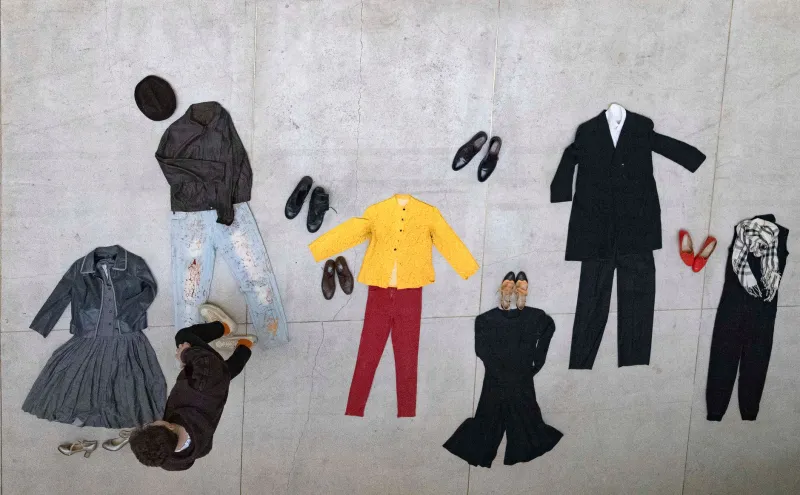
Photo: Seattle Municipal Archives from Seattle, WA, CC BY 4.0, via Wikimedia Commons
There is a particular kind of wardrobe problem that rarely announces itself. It does not announce itself as a stain, a tear, or an obviously outdated silhouette. Instead, it operates through subtle interference—the jacket that makes you feel slightly diminished in a meeting, the trousers that require constant adjustment throughout the afternoon, the blouse that photographs beautifully but leaves you self-conscious by noon. These are friction points: garments that, by design or by circumstance, work in opposition to the life you are attempting to lead.
A wardrobe audit, conducted properly, is not an exercise in self-criticism. It is, at its core, a design problem. And like any design problem, it benefits from clear criteria, honest observation, and a willingness to separate sentiment from function.
Begin With Behavior, Not Appearance
The most common mistake in any wardrobe evaluation is starting with how a garment looks on a hanger. Designers know that clothing only reveals its true character in motion, under real conditions, on an actual body. The appropriate starting point, therefore, is behavioral: how do you behave when you are wearing a specific piece?
Consider the last time you wore each garment. Did you pull at it? Did you avoid sitting down, standing up, or raising your arms? Did you feel the need to explain it—to preemptively qualify your appearance to a colleague or a friend? These behavioral cues are diagnostic. They indicate a mismatch between what the garment was designed to do and what your life requires of it.
A structured blazer engineered for a narrow, static silhouette may look authoritative on a rack but become a liability during a day that involves commuting, presenting, and moving between environments. The garment is not inherently flawed. It is simply misaligned with the demands being placed upon it.
The Proportion Problem
Of all the design variables that contribute to wearability, proportion is among the most consequential—and the most frequently overlooked. When a garment's proportions are misaligned with your body's natural architecture, the result is a subtle but persistent visual disruption that no amount of styling can fully resolve.
Consider the cropped jacket that sits precisely at the widest point of the hip, or the wide-leg trouser that breaks at a length that shortens the visual line of the leg. Neither piece is poorly made. Both, however, create proportional relationships that undermine rather than support the wearer's presence.
To identify proportion problems in your own wardrobe, stand before a full-length mirror and observe where each garment terminates on your body. Hemlines, sleeve lengths, and neckline depths all create horizontal divisions. When those divisions land at points of visual width rather than points of visual length, the garment is working against you. The solution is not always to discard the piece; occasionally, a tailor can reposition a hem or alter a sleeve to restore balance. But the first step is recognition.
Seam Placement and the Invisible Constraint
Seams are the architectural scaffolding of any garment. When placed with precision, they guide the eye, define the silhouette, and allow the body to move freely within the garment's structure. When placed carelessly—or designed for a body type that differs significantly from your own—they become invisible constraints.
The most common seam-related friction point in ready-to-wear clothing is the shoulder seam. In mass production, shoulder seams are standardized to fit a statistical average, which means they fit almost no one with complete accuracy. A shoulder seam that sits even a quarter-inch too far toward the neck will restrict arm movement and create a pulling sensation across the upper back. One that falls too far toward the arm will collapse the shoulder line and make even a well-fitted garment appear oversized.
When auditing your wardrobe, pay specific attention to how shoulder seams sit. Stand naturally, then raise both arms to a 45-degree angle. If the garment pulls across the back or the seam migrates from its intended position, you have identified a structural friction point that will diminish the garment's performance in virtually any context.
The Lifestyle Misalignment Test
Beyond fit and proportion, a significant category of wardrobe friction stems from lifestyle misalignment—garments acquired for a version of your life that no longer exists, or one that has not yet materialized.
This is particularly common in American wardrobes, where the gap between aspirational dressing and daily reality can be considerable. The formal silk blouse purchased for a professional environment that shifted to remote work. The performance-driven athleisure piece that entered the rotation during a fitness phase that has since evolved. The occasion dress acquired for a social calendar that no longer reflects your current circumstances.
None of these garments are failures. They are simply misaligned. To identify them, ask a direct question of each piece: does this garment serve the life I am actually living today, or the life I imagined when I purchased it? Honesty here is not harsh—it is efficient. A garment that has no place in your current life occupies not only physical space but cognitive space as well, creating low-level visual noise every time the closet door opens.
Addressing Restrictive Cuts
Cut—the way a garment is shaped through its pattern pieces—determines how freely the body can move within it. A restrictive cut does not always signal poor quality. Many beautifully constructed garments are deliberately cut close to the body, prioritizing visual precision over physical ease. The question is whether that trade-off is appropriate for your specific use case.
A pencil skirt with a narrow hem circumference may be impeccably tailored, but if your daily routine involves navigating stairs, extended periods of sitting, or any physical activity beyond a deliberate, measured pace, it will create constant friction. The same principle applies to slim-cut trousers with minimal seat room, fitted shirts that restrict arm extension, and structured coats that limit shoulder rotation.
To test for restrictive cuts, move deliberately while wearing each garment. Sit, stand, walk quickly, and reach forward. Note any point at which the fabric pulls, binds, or resists. These are not minor inconveniences—they are design signals indicating that the garment's intended use and your actual use are in conflict.
The Audit as Design Practice
When approached with the rigor and neutrality of a design review, a wardrobe audit becomes something more than a decluttering exercise. It becomes a process of clarification—a means of understanding not only which garments are failing you, but why, and what that reveals about the kind of clothing that genuinely supports your life.
The goal is not a smaller wardrobe for its own sake. It is a more coherent one: a collection of pieces whose proportions, construction, and cut are aligned with the body wearing them and the life being lived in them. Friction points, once identified, become instructive. They define, by contrast, exactly what a well-designed wardrobe should feel like—effortless, supportive, and entirely without interference.