Beyond the Curve: How Architectural Silhouettes Are Rewriting the Rules of Contemporary Design

For generations, the hourglass held an almost mythological authority over fashion design. Collections were built around it. Fitting rooms were judged against it. The entire vocabulary of tailoring — the nipped waist, the flared hem, the structured bust — existed largely to invoke or approximate it. But something fundamental has shifted in contemporary design studios, and the change is far more intentional than seasonal trend cycles might suggest.
Across emerging American labels and established design houses alike, a new silhouette language is taking hold. It is angular where the hourglass was curved, expansive where it was cinched, and deliberately ambiguous where it once sought to define. This is not minimalism for its own sake, nor is it shapelessness dressed up as philosophy. It is, in the truest sense, a design rebellion — one rooted in how a new generation of wearers understands their relationship with clothing and with their own bodies.
The Architecture of Refusal
To understand why designers are moving away from body-conforming silhouettes, it helps to understand what those silhouettes were always communicating. The hourglass shape, as a design ideal, emerged from a specific cultural moment — one that equated femininity with a particular physical ratio and treated clothing as a tool for achieving or signaling that ratio. Even as fashion evolved through the twentieth century, this underlying logic persisted in softer forms: the wrap dress, the fit-and-flare, the bodycon cut.
What contemporary designers are rejecting is not the female body itself, but the premise that clothing must negotiate with it in those terms. The new architectural approach treats the body as a point of departure rather than a template to be enhanced. Garments are constructed to exist in conversation with the wearer rather than in service of a predetermined ideal.
Think of the cocoon coat that adds volume without mapping it, or the boxy blazer that creates a clean vertical line regardless of the figure beneath it. These are not garments designed to hide — they are designed to assert. The distinction matters enormously.
Gender Fluidity as Design Logic
One of the most significant forces driving this shift is the growing irrelevance of gendered fit conventions in contemporary American fashion. Younger consumers, in particular, have moved away from the idea that clothing should announce or reinforce gender through silhouette. What was once a subcultural stance has become a mainstream design consideration.
For designers, this creates both a creative opportunity and a structural challenge. Traditional pattern-making and grading systems were built around gendered body assumptions. Constructing garments that read as neither masculine nor feminine in the conventional sense — while still feeling intentional and refined — requires a fundamental rethinking of how shape is generated.
The answer, for many contemporary designers, has been to look toward architecture and sculpture rather than toward traditional tailoring as a reference point. A garment is conceived as a three-dimensional object first, a wearable second. The body activates it; it does not define it.
This approach has produced some of the most visually compelling work in contemporary American fashion. Dropped shoulders that reframe the upper body entirely. Hemlines that exist in geometric tension with the floor. Sleeves that function almost as separate structural elements. The result is clothing that rewards close attention — design that reveals itself gradually rather than all at once.
Movement as the New Flattery
If the hourglass silhouette was designed to flatter a static body, the architectural silhouette is designed to flatter a body in motion. This is a subtle but profound reorientation of what fashion is supposed to do.
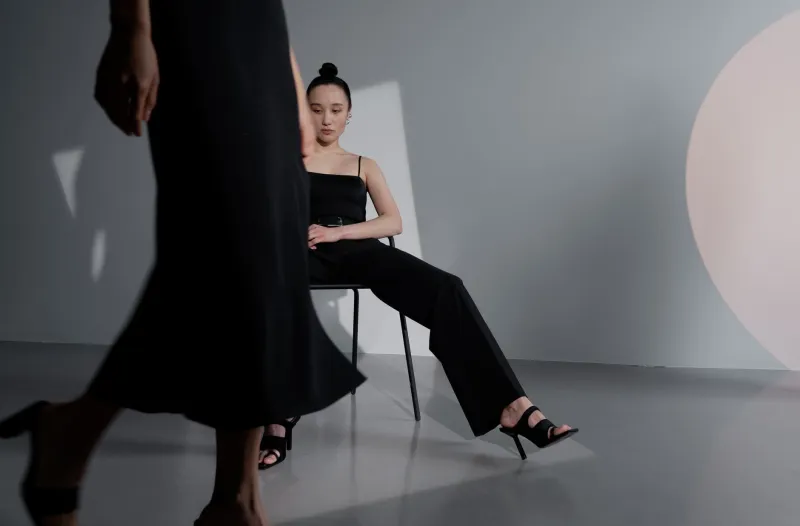
Contemporary designers working in this mode speak frequently about drape and fall — about how a garment behaves as the wearer moves through space. A wide-leg trouser that seems almost severe on the hanger becomes fluid and expressive in motion. An oversized shirt-jacket that reads as shapeless in a photograph reveals its structure when someone reaches, turns, or walks quickly. The garment is designed for the fourth dimension: time.
This emphasis on movement also has practical resonance with American consumers who have, particularly in the post-pandemic period, fundamentally reconsidered what they want from their clothing. Comfort is no longer a compromise — it is a standard. But the new architectural silhouette offers something beyond comfort. It offers the experience of wearing clothing that feels genuinely generous: generous with space, with interpretation, with possibility.
Letting the Wearer Define the Relationship
Perhaps the most philosophically interesting aspect of this shift is what it demands of the person wearing the clothing. A body-conforming garment tells a relatively fixed story. An architectural garment is, in a sense, an open proposition.
How a wearer carries themselves within a structural silhouette — whether they inhabit its volume confidently, belt it into something more defined, layer it against other strong shapes, or let it stand entirely on its own terms — becomes part of the garment's meaning. The designer creates the conditions; the wearer completes the design.
This collaborative dynamic represents a genuine evolution in the designer-consumer relationship. It asks more of the person getting dressed, but it also offers more in return. Clothing becomes less about conforming to an external standard and more about exercising a kind of daily creative agency.
At Joan Design, this philosophy resonates deeply. Design, at its most refined, does not impose — it invites. The best contemporary silhouettes are not statements made at the wearer's expense. They are structures built to be inhabited on the wearer's own terms.
What Comes Next
The architectural silhouette is not a trend with an expiration date. It is the outward expression of a cultural shift that has been building for years — one that questions who fashion is designed for, and on whose terms. As American consumers continue to move away from prescriptive beauty standards and toward a more individuated sense of personal style, the demand for clothing that accommodates rather than dictates will only grow.
For designers, this is a genuinely exciting moment. The constraints of the hourglass ideal, however invisible they once seemed, were real. Releasing those constraints opens the design space considerably. Structure, volume, proportion, and movement become the primary vocabulary — and within that vocabulary, the possibilities are, quite deliberately, expansive.